
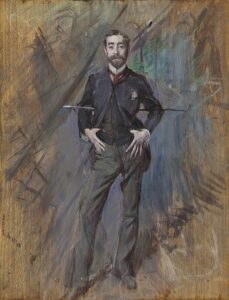
 After the scandal of “Madame X” (1884), Sargent had to flee Paris. This course surveys what he did next, how he settled in London, and became the most sought-after portrait painter of his day. We also consider his surprising later career as a war artist, and how he responded to the First World War. There will be a case study of his circle of friends, including the authors Robert Louis Stevenson, Henry James, and Edith Wharton. The focus with the latter will be on their responses to Sargent’s art in fiction, letters, and articles.
We will then contrast the work of Sargent’s fellow artists. Discover why he exhibited with his friend Monet but—when invited by Berthe Morisot—refused to join the Impressionists. Particular attention will be paid to his neighbours in Chelsea (James Whistler, Walter Sickert, John Collier) and the New English Art Club (which Sargent helped to found in 1886).
We end with a segment on the Shakespearian paintings of his friend and neighbour in Tite Street, the Anglo-American artist Edwin Austin Abbey. Sargent worked for decades with Abbey on murals for the Boston Public Library, and their working processes make a fascinating comparison.